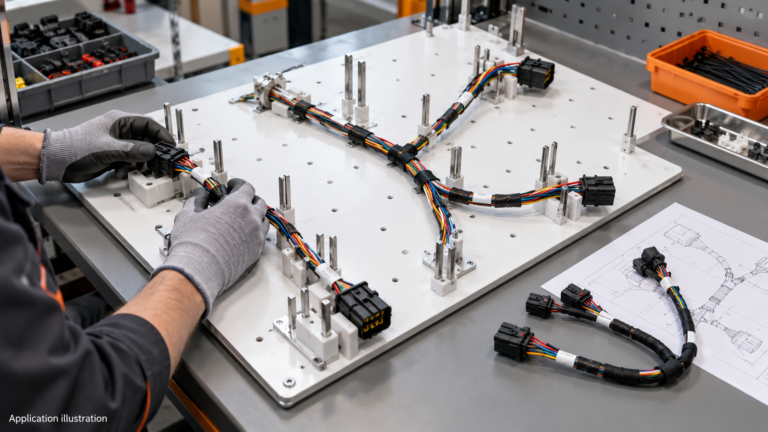
A wire harness spot taping machine should be evaluated with the tape and assembled workpiece you intend to use. Bundle diameter alone does not describe whether a branch can be positioned, wrapped and removed consistently.
This guide focuses on local wrapping at defined harness positions. For a wider equipment overview, see our wire harness assembly support equipment guide. For production requirements and trial planning, read how to choose wire harness assembly equipment.
1. Specify the job that the tape must perform
Identify the wrapping position on a drawing or photograph. Explain whether the operation holds a branch in position, provides local coverage or serves another documented assembly purpose. State which areas must remain uncovered and how the harness must bend after wrapping.
Do not assume that applying tape creates an approved electrical insulation system or provides a particular abrasion rating. Those requirements depend on the material, application and verification specified for the assembly.
A spot wrap at a branch is also different from wrapping a long harness section or bundling a finished cable for packaging. These operations may require different equipment and acceptance checks.
2. Identify the exact tape
Supply the tape manufacturer and product code, backing type, width, thickness and roll dimensions. Describe storage and handling conditions that could affect the trial. If alternative tapes are under consideration, identify them as separate trial materials.
Tape selection involves more than adhesion during a short demonstration. Review the intended environment, cable jacket compatibility, flexibility and any specified noise or abrasion requirements. tesa’s wire harnessing overview illustrates why different applications use different tape constructions. Its material guidance does not establish compatibility with a particular taping machine.
Ask the equipment supplier to confirm whether the proposed configuration can feed, cut and apply the exact tape. A general description such as “cloth tape” is not enough to establish processing suitability.
3. Check access around the wrapping position
Send photographs of the complete harness as well as close-ups of the target node. Include nearby connectors, sleeves, splices and short branches. Explain which components are already installed when the wrapping operation occurs.
- Can the operator present the wrapping position without forcing a branch?
- Is there sufficient clearance around nearby connectors?
- Can the harness be supported without pulling on completed connections?
- Can the wrapped assembly be removed without disturbing the tape?
- Does another product variant change the available access?
Include representative difficult parts in the trial. A demonstration on a loose straight bundle does not establish suitability for a compact assembled branch.
4. Define the finished wrap
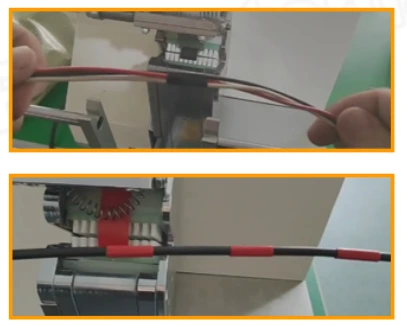
Replace “wrap neatly” with observable acceptance criteria. Specify the intended location, coverage and any required overlap or wrap count. Identify the permitted starting and finishing conditions and the areas where adhesive must not remain exposed.
| Check | Question for the trial |
|---|---|
| Position | Does the wrap remain within the designated zone? |
| Coverage | Does the finished wrap match the assembly requirement? |
| Finishing | Is the tape end secured according to the agreed criteria? |
| Workpiece condition | Are wires, jackets and nearby components undamaged? |
| Routing | Can the finished branch still bend and fit as required? |
| Handling | Does the wrap remain acceptable after specified downstream handling? |
If environmental conditioning or longer-term checks are required, agree them separately. Immediate appearance does not establish durability over the product’s service life.
5. Diagnose an unacceptable sample systematically
If the tape end lifts, first document where and when it occurs. Review the tape identity and condition, contamination, end placement, workpiece geometry and the agreed application settings. Avoid assuming that increasing tension is the correct response.
If coverage varies, examine how the workpiece is located and supported, whether branches move during loading and whether the intended recipe is selected. If feeding or cutting is inconsistent, follow the machine instructions for inspecting the tape path and consumable tooling.
Use trained personnel and the prescribed isolation procedure before reaching into the mechanism. Retain failed samples and change one relevant factor at a time so the results remain interpretable.
6. Measure the complete operator cycle
Measure picking up the harness, positioning, wrapping, unloading, checking and transferring it. Document whether quoted processing times include these activities. Also observe tape replenishment, normal interruptions and product changeover.
For a high-mix workstation, compare the effort needed to move between representative harnesses. A faster individual wrap may offer limited benefit if the operator spends most of the cycle supporting and repositioning the assembly.
Prepare a useful sample trial request
Provide the harness drawing or photographs, exact tape specification, wrapping locations, product variations and required output. Include an approved reference sample or written acceptance criteria and explain the current production difficulty.
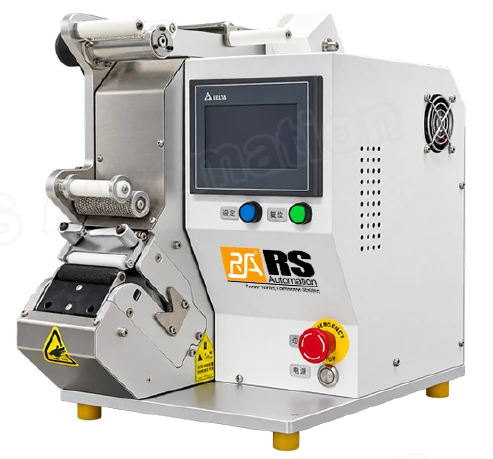
The RSM-TW-50A benchtop wire spot taping machine is one equipment option to discuss for this task. Confirm material compatibility, workpiece access and the proposed configuration through application review and representative samples.
Contact RS Automation with your spot taping application to discuss the information needed for evaluation. Keep the trial record so the accepted materials, settings and inspection method can be transferred into production.