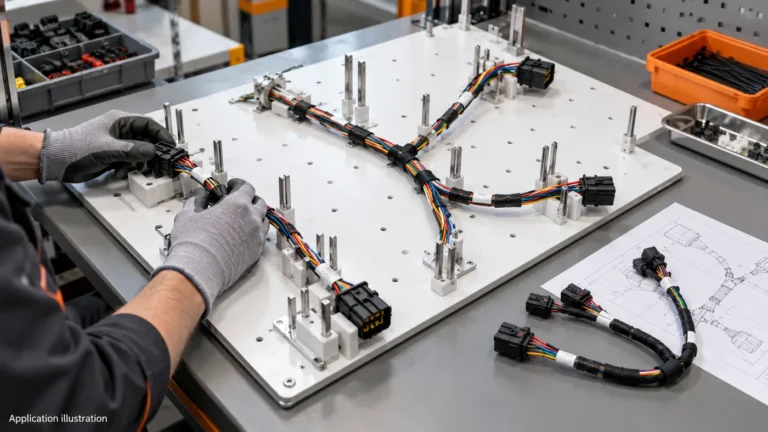
Film bundling for wire harnesses is a finishing and handling operation. The aim is to hold the intended arrangement together while protecting the cables, connectors and identification through the next transfer or packing step. A neat band is useful, but its appearance alone does not prove adequate holding or acceptable surface pressure.
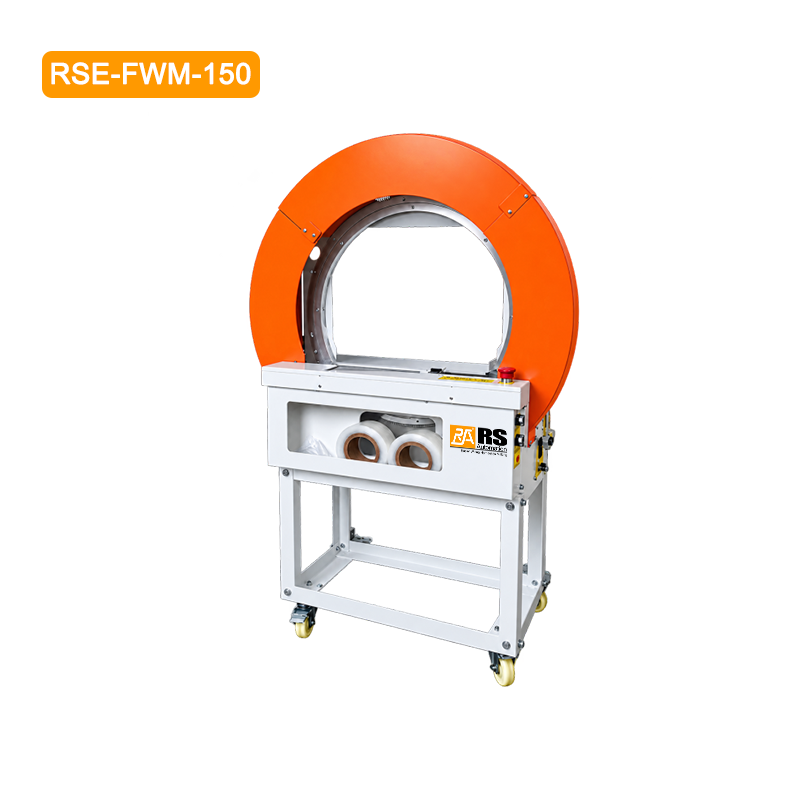
This guide expands the finished-product section of our wire harness assembly support equipment overview. It covers application checks for the RSE-FWM-150 automatic film strapping machine and explains what to include in a representative packing trial.
1. Distinguish product bundling from local joint wrapping
A finished harness may need to remain coiled, grouped or supported during handling. Define that requirement before selecting the machine. Identify where bands may be placed and which sections must remain free so the next operator can inspect, unpack or install the product.
Local spot taping serves a different purpose. The RSM-TW-50A wire spot taping machine is described for fine-wire solder joints and nodes; film bundling should not be presented as an approved substitute for that joint-covering operation.
Where joining occurs earlier, use the wire splicing applications and process setup guide to plan the preceding task. Its joint requirements remain separate from how a completed harness is grouped for packing. Specify insulation, protection and packaging requirements independently.
2. Measure the entire bundle, not only the cable diameter
A coil’s cable diameter does not describe its loading envelope. Record the maximum outside dimensions in the arrangement that will actually enter the machine. Include connectors, branch exits, protective covers and any required support. Identify whether the product must be rotated or passed through the opening during loading.
Consider variation within the same job family. A small connector may clear the head comfortably, while a larger branch or angled backshell changes the loading path. Use representative assemblies rather than approving all jobs from the smallest sample.
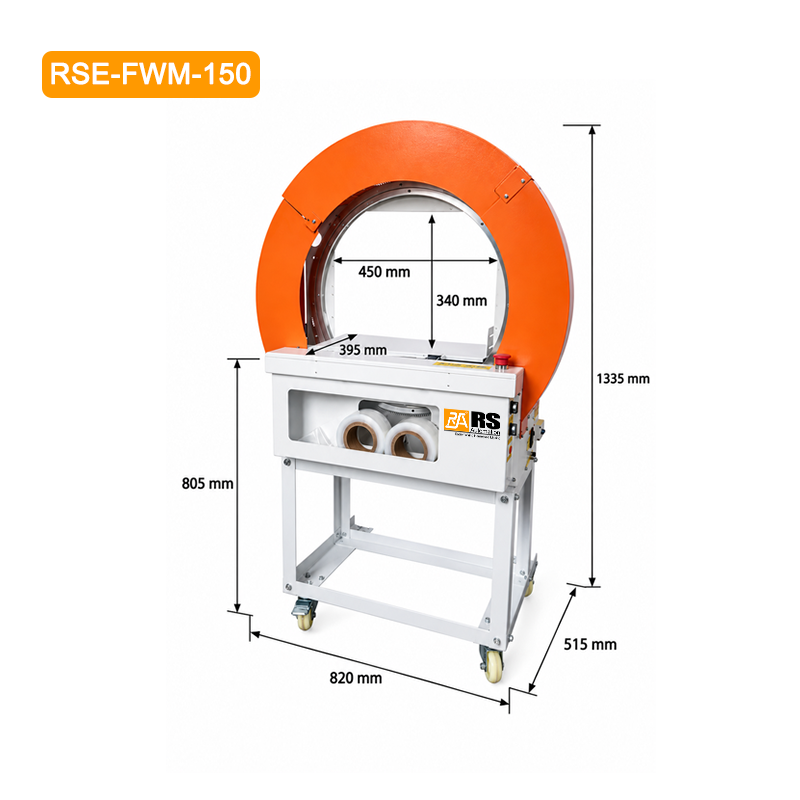
Record bundle weight and the way it is supported before and after the cycle. Ask whether the workstation needs an additional support surface and confirm what is included in the quotation. Do not assume the machine carries the full weight of a long assembly simply because the opening appears large enough.
For smaller bundles, the supplier also lists the RSE-FWM-145 stretch film bundling machine. Compare the actual opening, material and handling requirements of each configuration rather than treating the model number as a capacity rule.
3. Find a useful holding condition without damaging the product
Define how firmly the product must be held and how the band will later be removed. Too little restraint may allow the arrangement to move; an excessive or poorly located band may mark insulation, load a connector or distort a soft bundle. The acceptable condition depends on the product and downstream handling.
The RSE-FWM-150 listing describes adjustable tension, 50 mm film and glue-free hot-melt sealing. Confirm the approved film specification with the supplier. Width alone does not define the consumable: film construction, thickness and roll format may also affect the proposed setup.
Check band position and the finished seal
Identify permitted contact zones on the drawing or a sample photograph. Keep the band away from protruding features and areas that should not carry the load. Check that identification stays readable and that the packed arrangement can be released without damaging the product.
Inspect the seal and film after the intended handling sequence. Specify the holding and removal criteria before deciding whether the sample passes. Do not infer transportation performance from a brief bench demonstration; if distribution testing is required, agree the relevant procedure for the packed product.
4. Build a repeatable sample and handling trial
| Check | What to include | Record |
|---|---|---|
| Loading clearance | Largest connector, branch and coil arrangement | Envelope dimensions and loading sequence |
| Product condition | Soft insulation, labels and sensitive surfaces | Before/after photographs and inspection result |
| Holding | Agreed normal transfers and packing movements | Movement, band condition and pass/fail criterion |
| Film and seal | Proposed roll specification and settings | Consumable identity and finished seal assessment |
| Release | How the next station removes the band | Access, residue or surface damage if present |
| Changeover | Different bundle sizes and packing arrangements | Setup time and first-piece checks |
Keep material and assembly identities traceable to the result. Record unsuccessful trials, because they identify limitations or changes that still require evaluation. A selected successful sample should not be described as validation of every harness construction.
Define who inspects the first piece and what happens when the film roll changes, the product arrangement changes or a finished band does not meet the agreed check. The operator needs a clear response rather than an instruction to keep increasing tension until the bundle looks tight.
5. Compare the full packing cycle and accepted output
The product page lists foot-pedal and sensor triggers and up to 12 cycles per minute in a three-loop mode. Treat that as a stated machine-cycle condition, not a guaranteed rate of packed harnesses ready for shipment. Confirm the setting and sample used when comparing demonstrations.
A complete cycle can include coiling or arranging the harness, locating the band zone, loading, triggering, unloading, inspection and transfer to a carton or rack. Include the time for correcting a loose arrangement and for changing products or consumables. Compare accepted output under the same handling assumptions.
Review operator access and trigger behavior with the proposed workstation. Verify that loading and removal follow the supplied operating instruction. Confirm guarding, stop functions and maintenance arrangements on the actual configuration; do not infer safety performance from a product photograph.
Prepare a useful bundling-machine enquiry
- Provide photographs and maximum dimensions of the loaded bundle, including connectors and branches.
- Identify insulation, labels and surfaces that must not be marked or compressed.
- Describe the required holding condition and the next handling or packing operation.
- State product mix, output target and how frequently jobs change.
- Include film requirements and the inspection or distribution tests required by the customer.
Send the bundle details to RS Automation and request a trial tied to the proposed machine, consumable and setup. Keep the resulting evidence with the packing instruction so another operator can reproduce the reviewed arrangement.
Common selection questions
Can film bands replace cable ties or protective tape? Decide from the intended function and customer requirement. A temporary packing restraint, a permanent fixing and a joint covering are different jobs. This guide does not establish interchangeability.
Should tension be set to the maximum? Select and verify a setting that meets holding and surface-condition requirements. Maximum tension is not a universal target.
Is a large opening enough to approve the machine? No. Check the loading path, support, band position, trigger arrangement, seal and removal method on representative assemblies.
Sources and review scope
RSE-FWM-150 features, cycle conditions and images were checked against its linked product page on October 26, 2026. Related equipment links describe separate process options. The inspection matrix is a proposed trial framework; no customer testing, transport qualification or measured output improvement is claimed.